Portfolio case study
Chess Data Platform
A medallion lakehouse on Microsoft Fabric over Magnus Carlsen’s public chess.com game history: 9,772 games since 2014, replayed move by move, modeled as a star schema and reported in Power BI.
chess.com API→Bronze→Silver→Gold→Azure SQL + Direct Lake→Power BI
The question the platform answers
“Where does a player lose points, and what should they practise?”
- Source: the chess.com public API, one JSON archive per player per month.
- Platform: a Fabric F2 capacity, OneLake lakehouses, Spark notebooks, Data Factory pipelines.
- Serving: an Azure SQL star schema and a Power BI Direct Lake model.
- Configuration: the tracked account is a row in a config table. No account name lives in a pipeline, a notebook or the report.
- Schedule: a run is daily, weekly or monthly by setting. The capacity is paused between runs.
Live from the mart’s load audit. Last run: 24 Sep 2026.
- Microsoft Fabric
- OneLake
- Delta Lake
- PySpark
- Fabric Data Factory
- Azure Data Factory
- Azure SQL
- Direct Lake
- TMDL / PBIR
- Key Vault
- Entra ID
- GitHub
Architecture
A medallion lakehouse on Microsoft Fabric
Left to right. A Copy activity lands the API responses, PySpark notebooks refine bronze to silver and silver to gold, and a Copy activity publishes gold to Azure SQL by truncate and reload. The Fabric workspace and the Azure resources sit in separate directories, bridged by one service principal; secrets are in Key Vault; a contained SQL user does the load and nothing else.
mart.tracked_account, runs PL_Chess_Bronze per account, then PL_Chess_Transform for silver, gold and publish.- Source
api.chess.com player game archives, one JSON per month.
originexternal REST API - Bronze
lh_bronze / Files. Raw JSON, exactly as returned.
Fabric Copy activityHTTP, binary - Silver
lh_silver / Tables. Delta: chess_game, chess_move.
PySpark notebooknb_silver_chess - Gold
lh_gold / Tables. Delta star schema, 11 tables.
PySpark notebooknb_gold_chess - Serve
Azure SQL mart.* plus a Direct Lake semantic model.
Copy activityTRUNCATE + INSERT - Consume
Power BI report: 6 pages, 37 measures.
Direct Lake / Importand the browser dashboard
Naming conventions
Each item name says what kind of thing it is, then what it is for, so a workspace listing or a run log reads without a legend.
| Prefix | Kind | Examples | Rule |
|---|---|---|---|
| lh_ | Lakehouse | lh_bronze, lh_silver, lh_gold | One per medallion layer, named for the layer. |
| PL_ | Pipeline | PL_Chess_Monthly, PL_Chess_Bronze, PL_Chess_Transform | Domain, then role. The parent carries its cadence in its name; children carry the stage. The ADF bracket is PL_Mart_Chess_Monthly, so the two orchestrators read apart in a log. |
| nb_ | Notebook | nb_silver_chess, nb_gold_chess | The layer it writes, then the domain. |
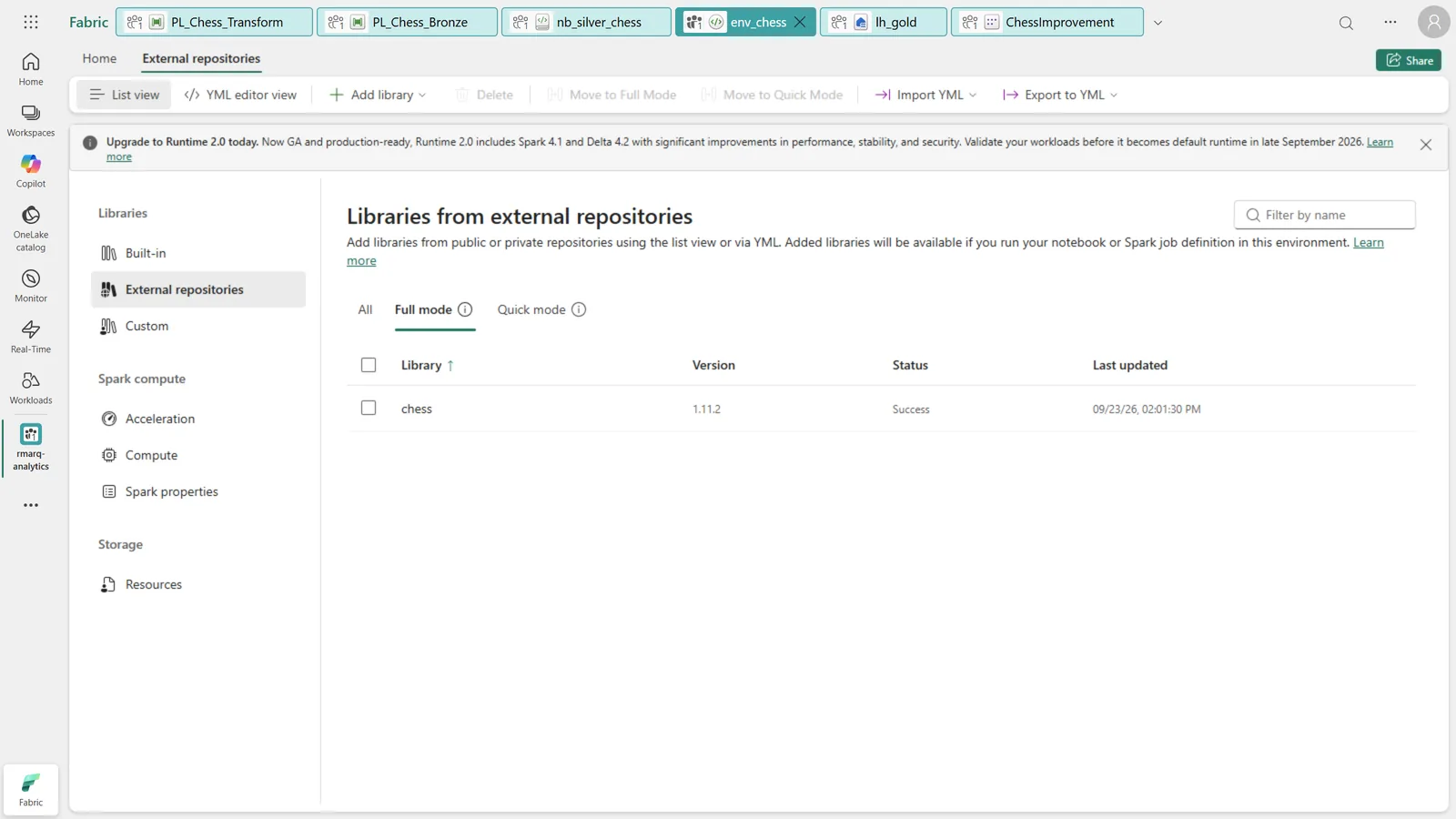
| env_ | Spark environment | env_chess | The domain whose libraries it pins. |
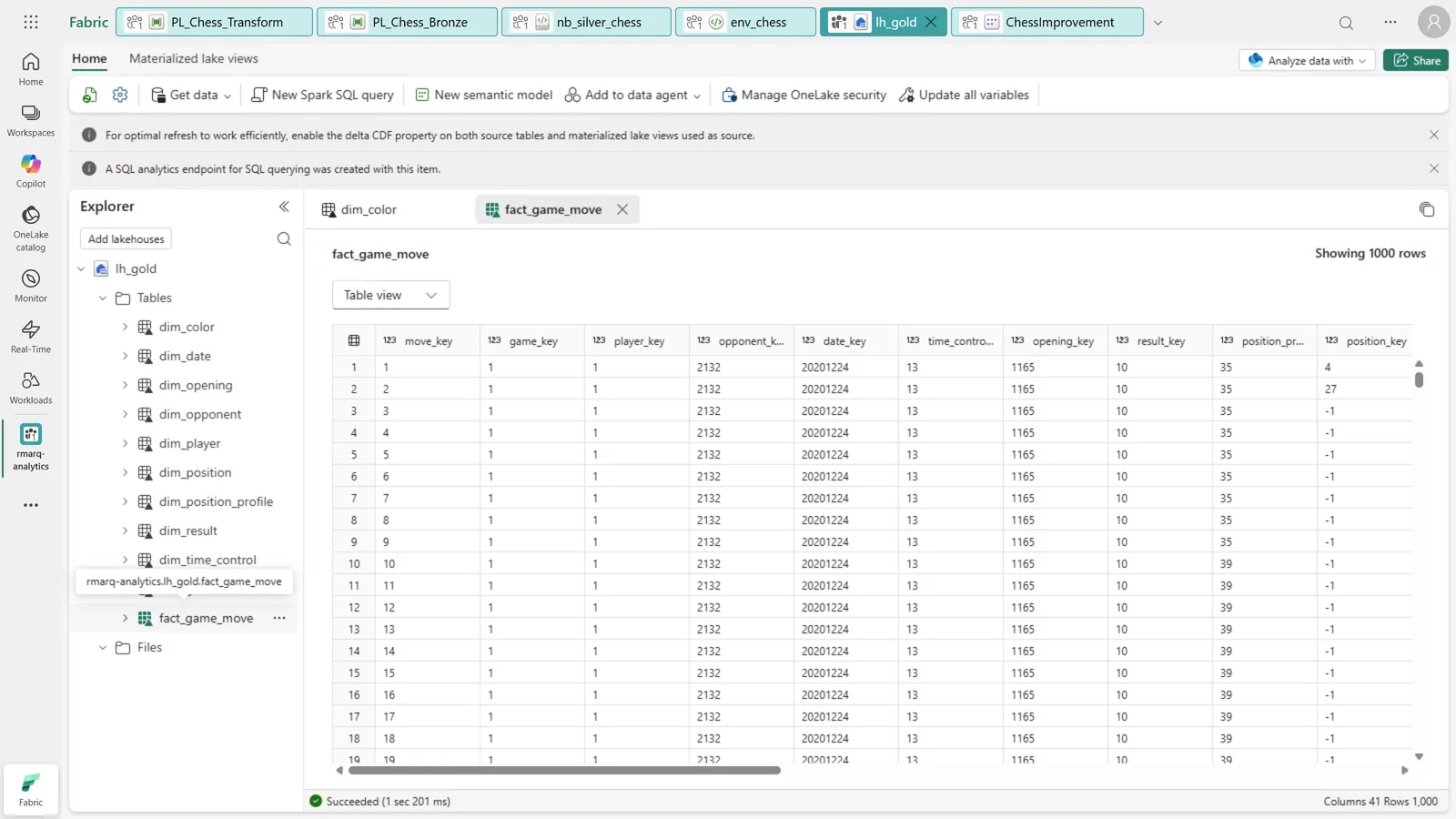
| dim_ / fact_ | Gold tables | dim_opening, fact_game_move | Kimball: dimensions by subject, facts by grain. Keys end in _key; the unknown member is −1. |
| chess_ | Silver tables | chess_game, chess_move | Domain, then the real-world entity, one row each. |
| mart. | Azure SQL schema | mart.fact_game, mart.load_audit, mart.tracked_account | The serving copy of gold, its audit, and the config table, in one schema a login can be scoped to. |
| DS_ / LS_ / TR_ | ADF datasets, linked services, triggers | DS_Mart_LhBronze_Binary, TR_Mart_Chess_Monthly | ADF’s own object types keep their own prefixes. |
A run
One run, start to finish
Timings from the load on 24 September 2026. The publish step is the longest because the move fact is 871,210 rows. Spark jobs started by a service principal fail in Fabric with “unable to acquire user token”, so a user-owned Fabric schedule runs the work and ADF only resumes and pauses the capacity.
- ADFResume the F2 if paused.
- ADFPoll until Active, settle a minute.
- FabricThe schedule fires the parent; it looks up the tracked accounts.
- BronzeLand the newest archives, four at a time.
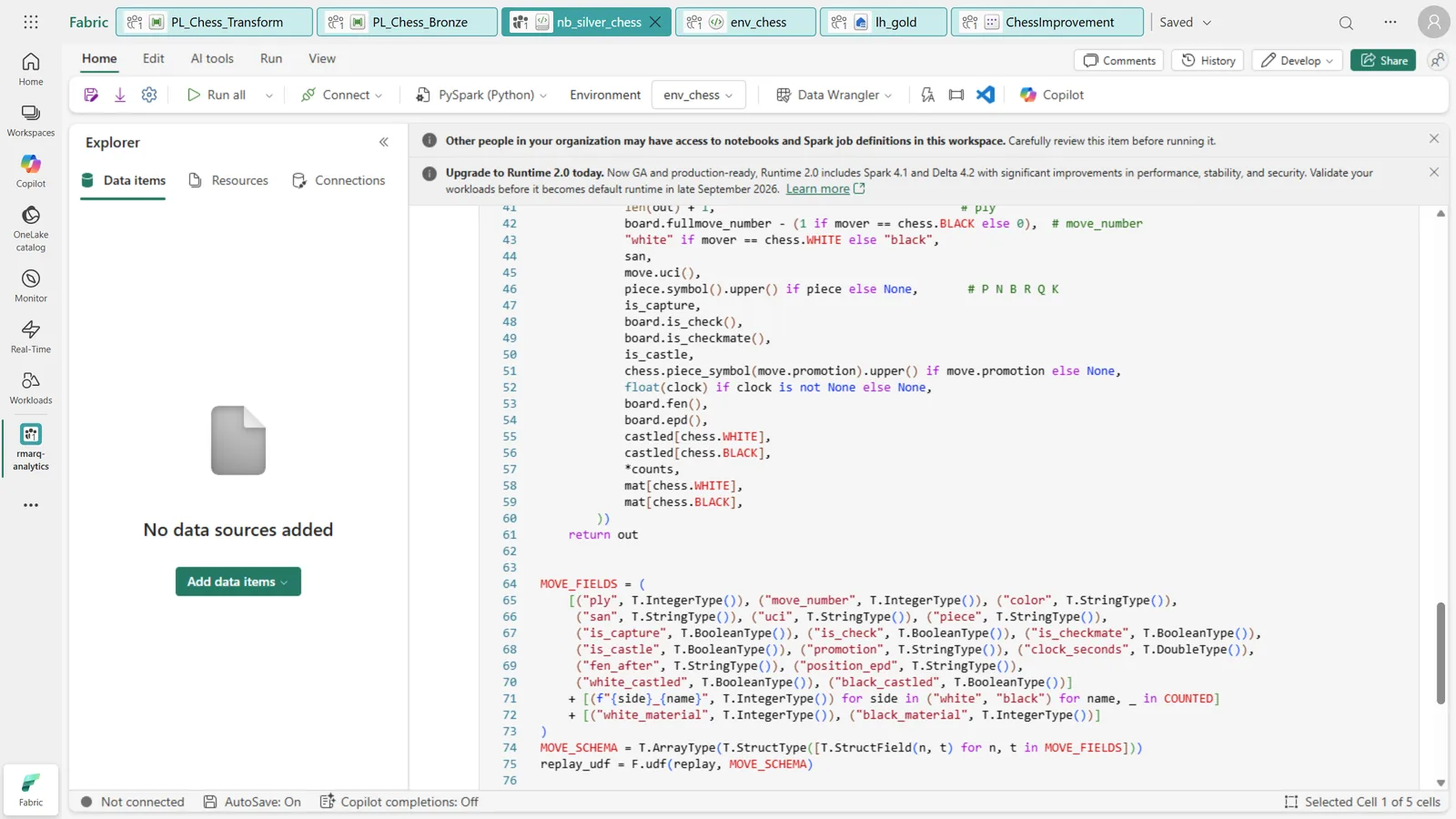
- SilverFlatten, reshape, replay every game.
- GoldDimensions, facts, surrogate keys.
- PublishCopy gold to Azure SQL, write the load audit.
- ADFSees the run finish and pauses the F2.
Layer 1
Bronze: the source as it arrived
Bronze is a replayable copy of the source. Because the API bytes are kept, silver and gold can be rebuilt without calling the API again, and an account that stops being tracked keeps its archives on disk. The folder names become partition columns when Spark reads them.
- Where
- lh_bronze / Files in OneLake, not Tables.
- Format
- Raw JSON, byte for byte the API response.
- Layout
- One file per player-month, Hive-style folders.
- Volume
- 66 archives, December 2014 to today.
- Rule
- Never edited. The newest archives are re-landed each run.
PL_Chess_Bronze
- Lookup the archive list
- Set variable: last N months
- ForEach, 4 in parallel
- Copy binary, HTTP to lakehouse
lh_bronze/Files/chessdotcom/games/
  username=<account>/
    archive=2026-08/games.json
    archive=2026-09/games.json

{ "games": [ {
  "url": ".../game/live/...",
  "time_control": "180+2",
  "time_class": "blitz",
  "rated": true,
  "end_time": 1785721149,
  "eco": ".../openings/Sicilian-Defense...",
  "white": { "rating": 3262, "result": "win",
             "username": "<account>" },
  "black": { ... },
  "pgn": "[Event ...] 1. d4 {[%clk 0:03:02]} ..."
} ] }
Layer 2
Silver: one row per game, one per move
The notebook keeps the accounts it is handed, flattens the JSON, reshapes white and black into player and opponent, and replays every game with python-chess to get the board position, material and clocks after each move. The library is pinned in a Fabric Environment so every Spark executor has it.
- Where
- lh_silver / Tables as Delta.
- chess_game
- 9,772 rows, one per game from the tracked player’s side.
- chess_move
- 871,210 rows, one per half-move.
- Checked
- The replay was tested locally against real archives before it ran on Fabric: every final position matched chess.com’s own.
chess_move, a 3+2 blitz game from August 2023
| ply | side | SAN | piece | capture | castle | clock | material W / B | position after |
|---|---|---|---|---|---|---|---|---|
| 1 | white | d4 | P | 182.0 | 39 / 39 | rnbqkbnr/pppppppp/8/8/3P… | ||
| 2 | black | d5 | P | 182.0 | 39 / 39 | rnbqkbnr/ppp1pppp/8/3p4/… | ||
| 3 | white | Bf4 | B | 183.2 | 39 / 39 | rnbqkbnr/ppp1pppp/8/3p4/… | ||
| 6 | black | dxe4 | P | yes | 172.7 | 38 / 39 | rnbqkbnr/pp2pppp/8/2p5/… | |
| 13 | white | O-O-O | K | yes | 180.4 | 38 / 39 | rnbqkb1r/1p3ppp/p3pn2/… | |
| 19 | white | Rxd5 | R | yes | 160.9 | 34 / 35 | rnb1kb1r/1p3ppp/p7/q1pR4… |
Layer 3
Gold: a Kimball star schema
Two facts at different grains share seven conformed dimensions, so a slicer on time control or opening filters games and moves alike. The move fact carries two dimensions of its own. Surrogate keys are generated in Spark; a −1 member stands in for unknowns. The whole mart is truncated and reloaded each run, which is why there is no merge logic at this scale.
- dim_date4,748 rows
- dim_player1 row
- dim_opponent1,314 rows
- dim_time_control17 rows
- dim_opening4,950 rows
- dim_result15 rows
- dim_color2 rows
The position stays on the fact rather than in a dimension: 86% of the 871,210 positions occur in exactly one game, so a row per position would be as large as the fact. dim_position keeps the positions reached in five or more games, which is the opening tree the report’s explorer reads.
Serving
Serving: Azure SQL and Direct Lake
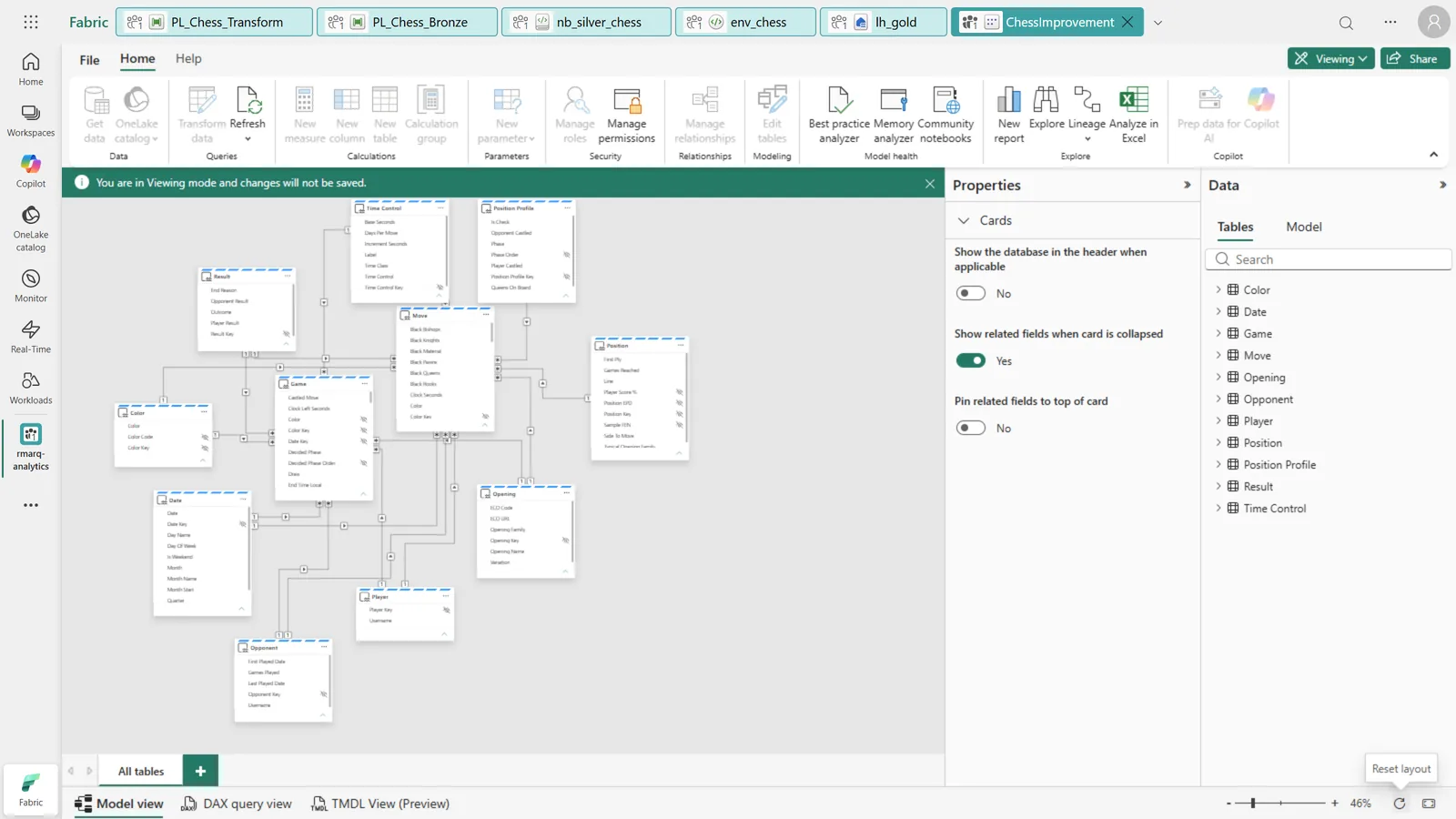
The ChessImprovement semantic model reads the Delta tables in lh_gold through Direct Lake; the deploy script reframes it after each run. The same 11 tables are copied to Azure SQL, which stays available while Fabric is paused and feeds the live figures on this page. The model and the report are generated by a script from the gold schema and pushed through the Fabric REST API, so nothing is edited by hand.
- Model: 11 tables, 16 relationships, 37 measures in display folders, hidden keys, friendly names, sort-by columns.
- Report: six pages, one question each, sliced by time control and colour. The player’s name comes from the model, not the report.
- Checked: every measure was run through the executeQueries API before a visual used it.
- Import twin: the generator also writes an Import-mode project on Azure SQL for Power BI Desktop.
measure 'Performance Rating' =
    [Avg Opponent Rating]
      + 400 * DIVIDE([Wins] - [Losses], [Games])
  formatString: #,0
  displayFolder: Rating

measure 'Conversion %' =
    CALCULATE([Score %],
      'Game'[Max Material Diff] >= 3)

partition Game = entity
  mode: directLake
  source
    entityName: fact_game
    expressionSource: DatabaseQuery
Fabric
The workspace
Fabric draws the lineage from the items and their connections. Pipeline canvases were captured before the account lookup was added to the parent.
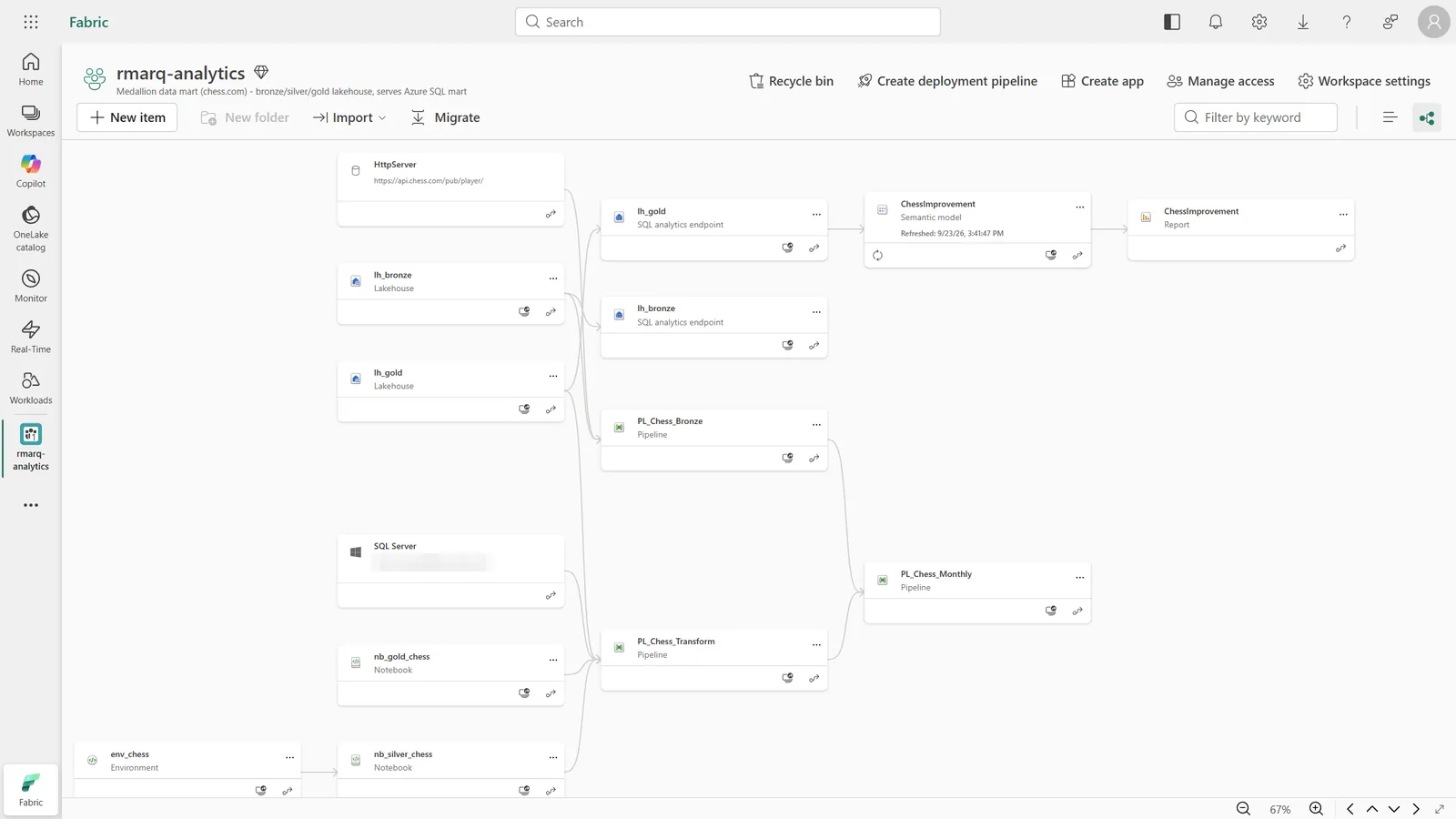
An HTTP connection for the chess.com API and a SQL connection feed the pipelines. env_chess supplies python-chess to the silver notebook. The gold lakehouse’s SQL endpoint feeds the semantic model, which feeds the report.
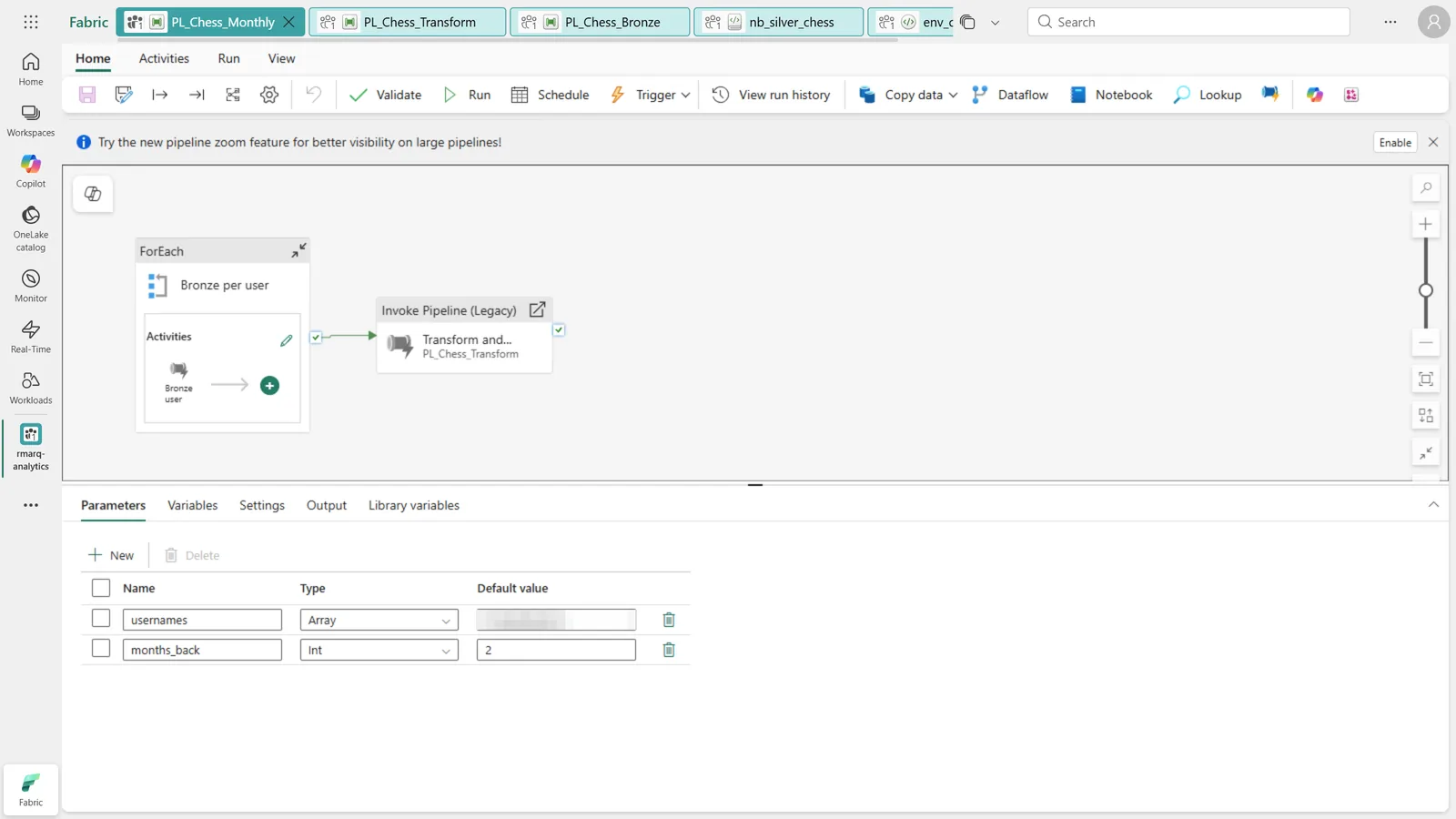
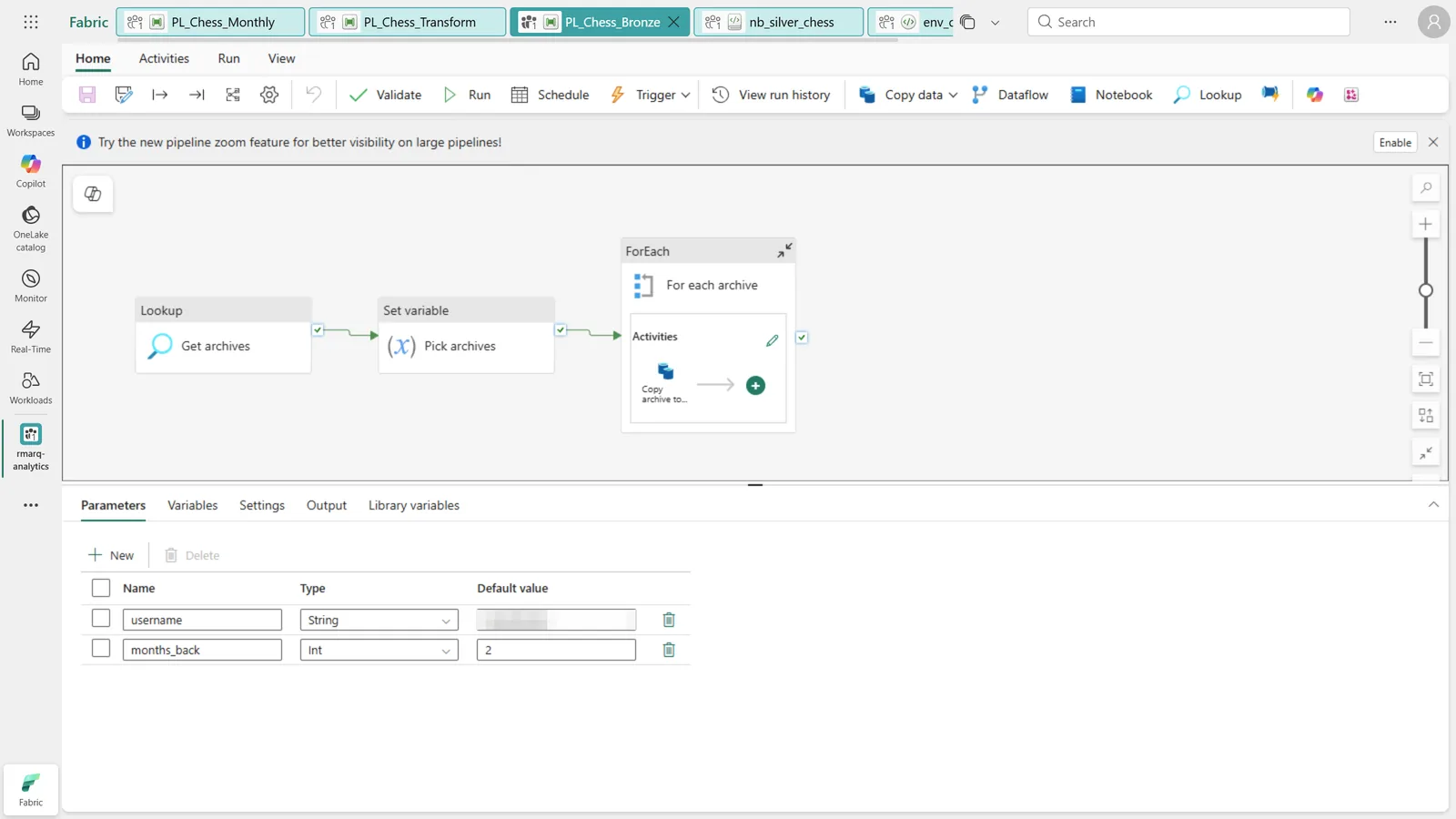
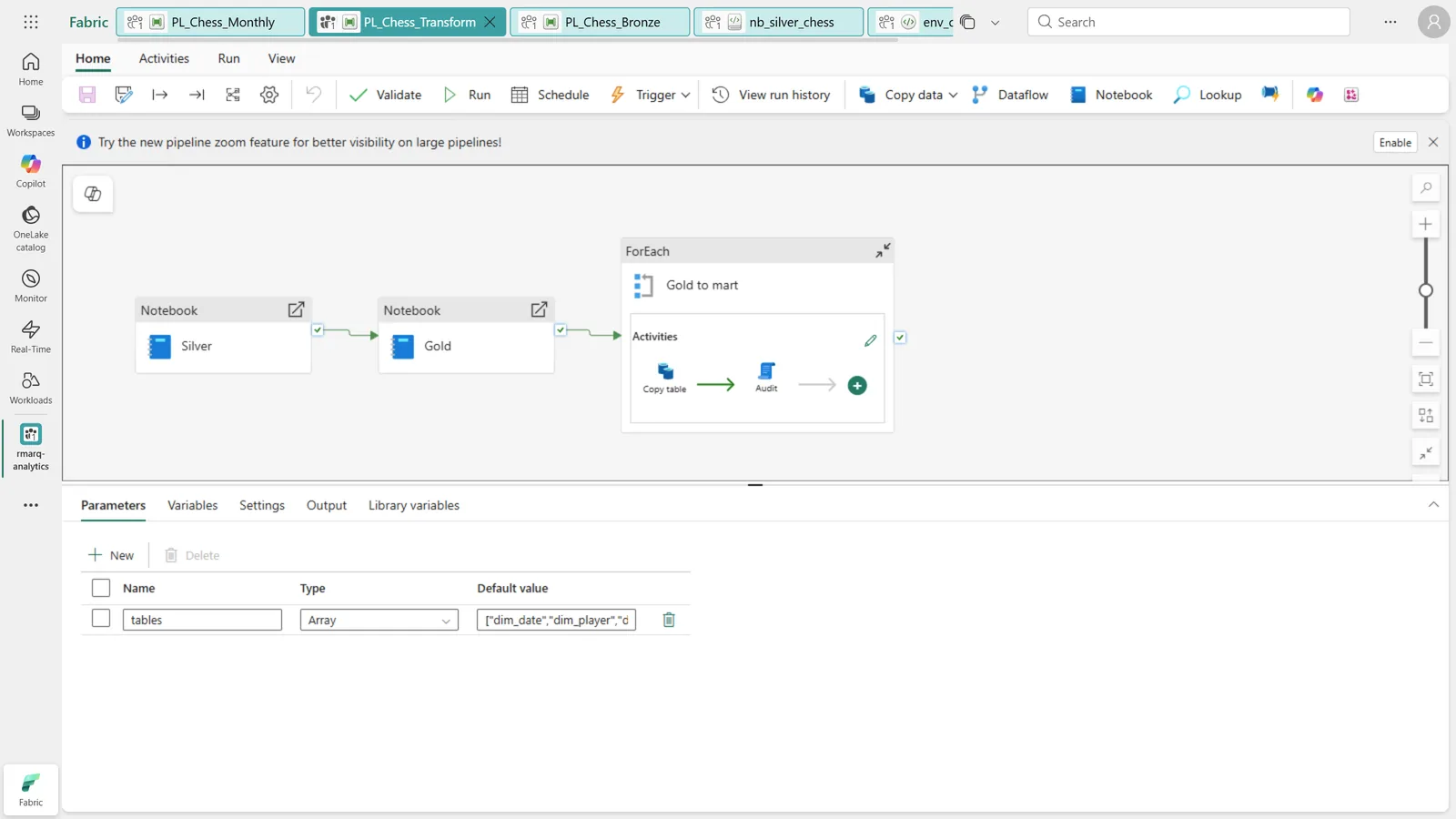
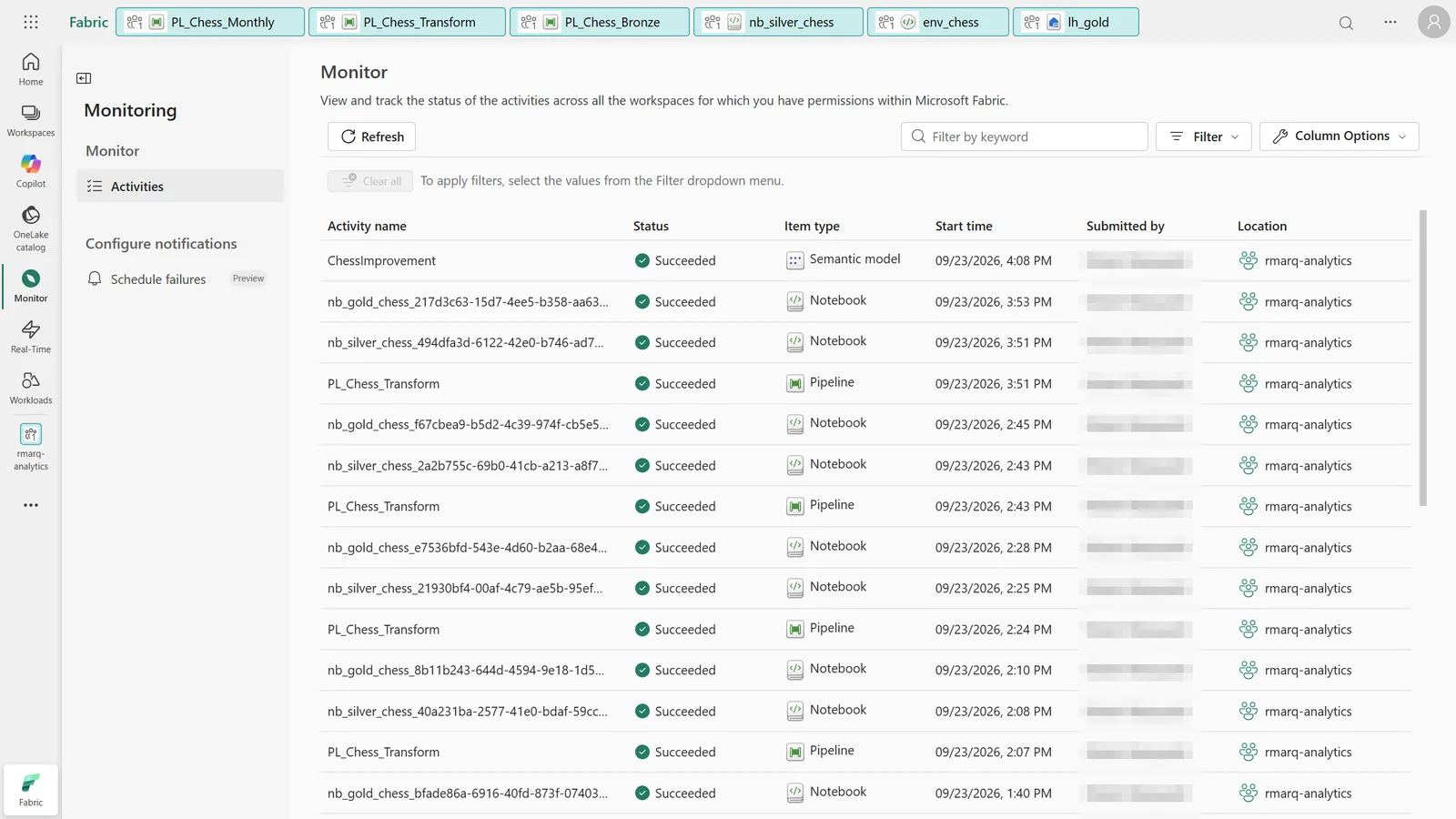
Pipeline, notebook and semantic model runs with status and start time. Each publish also writes a row per table to mart.load_audit.
Power BI
The report
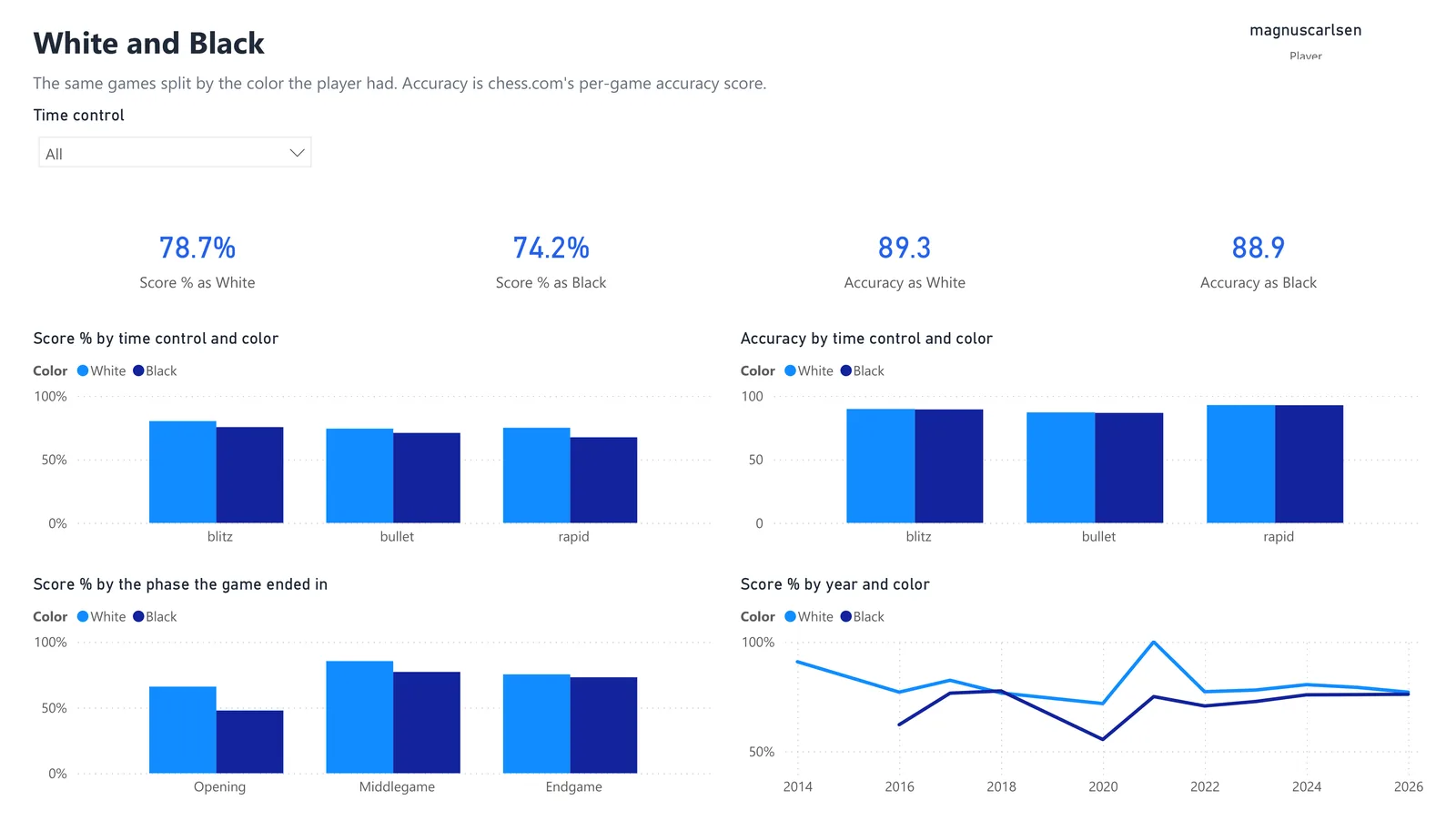
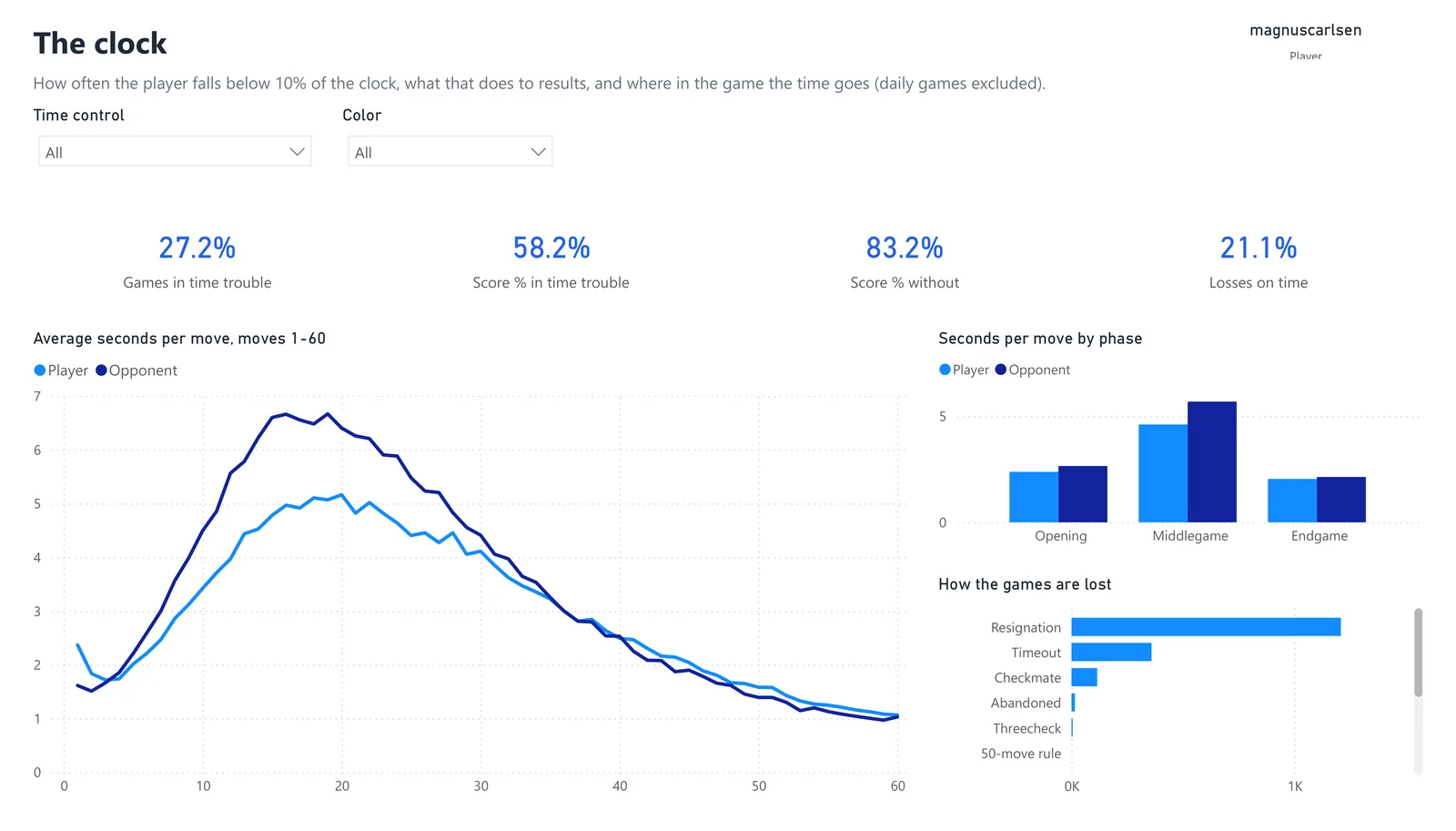
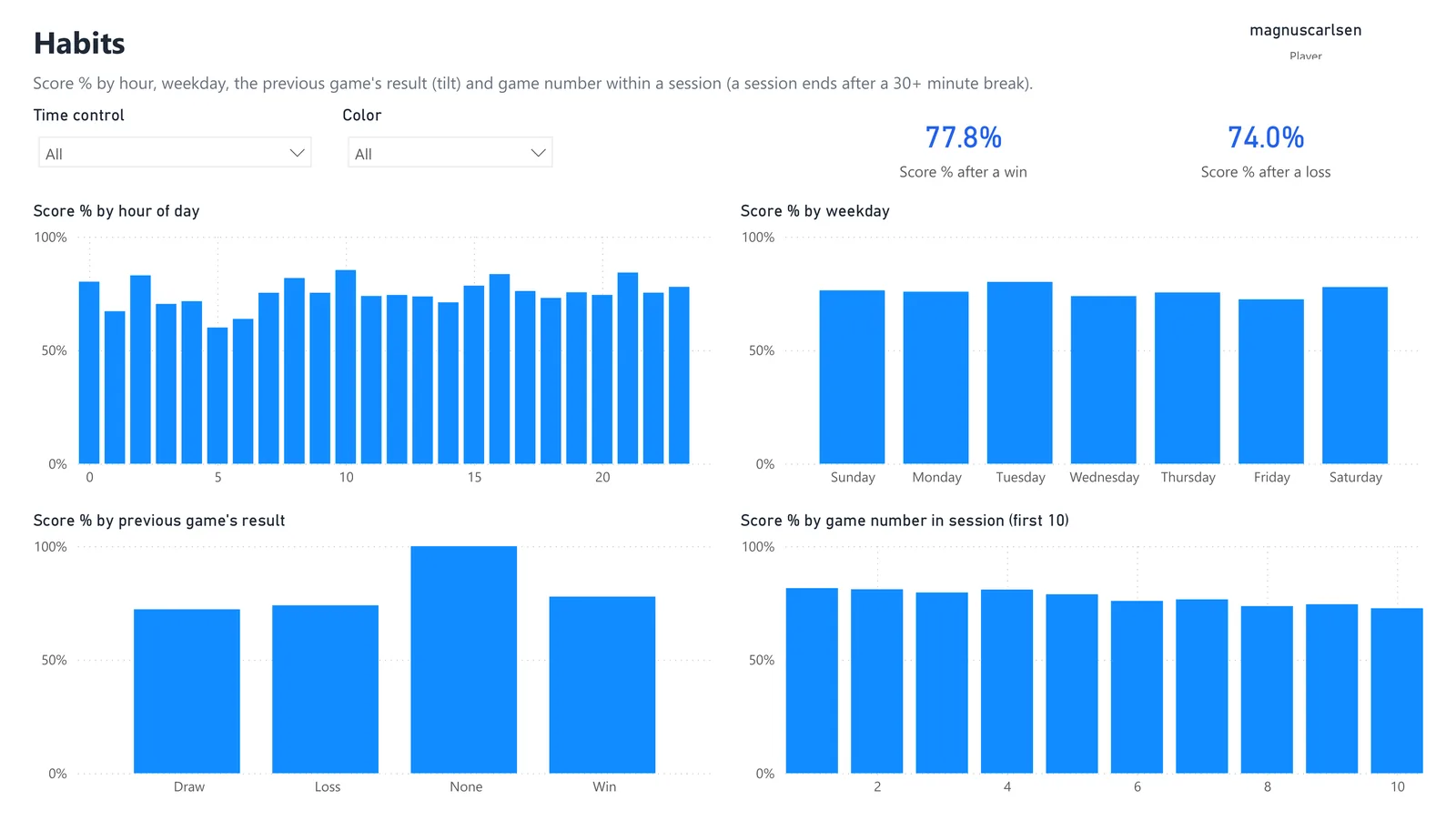
Six pages, one question each, over 9,772 games. Every page can be sliced by time control and by the colour played. The figures below are from the 24 September 2026 load.
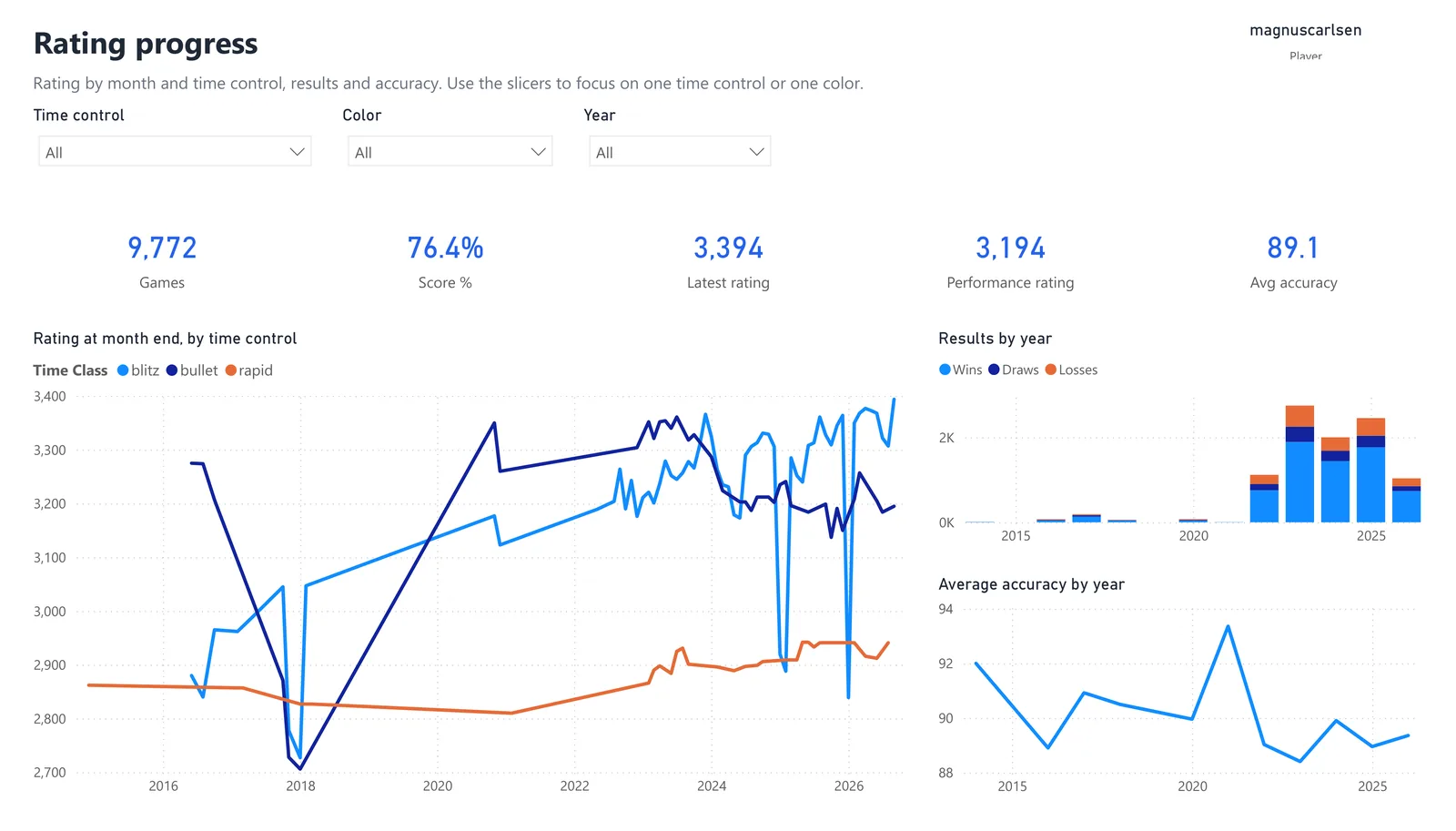
Rating progress
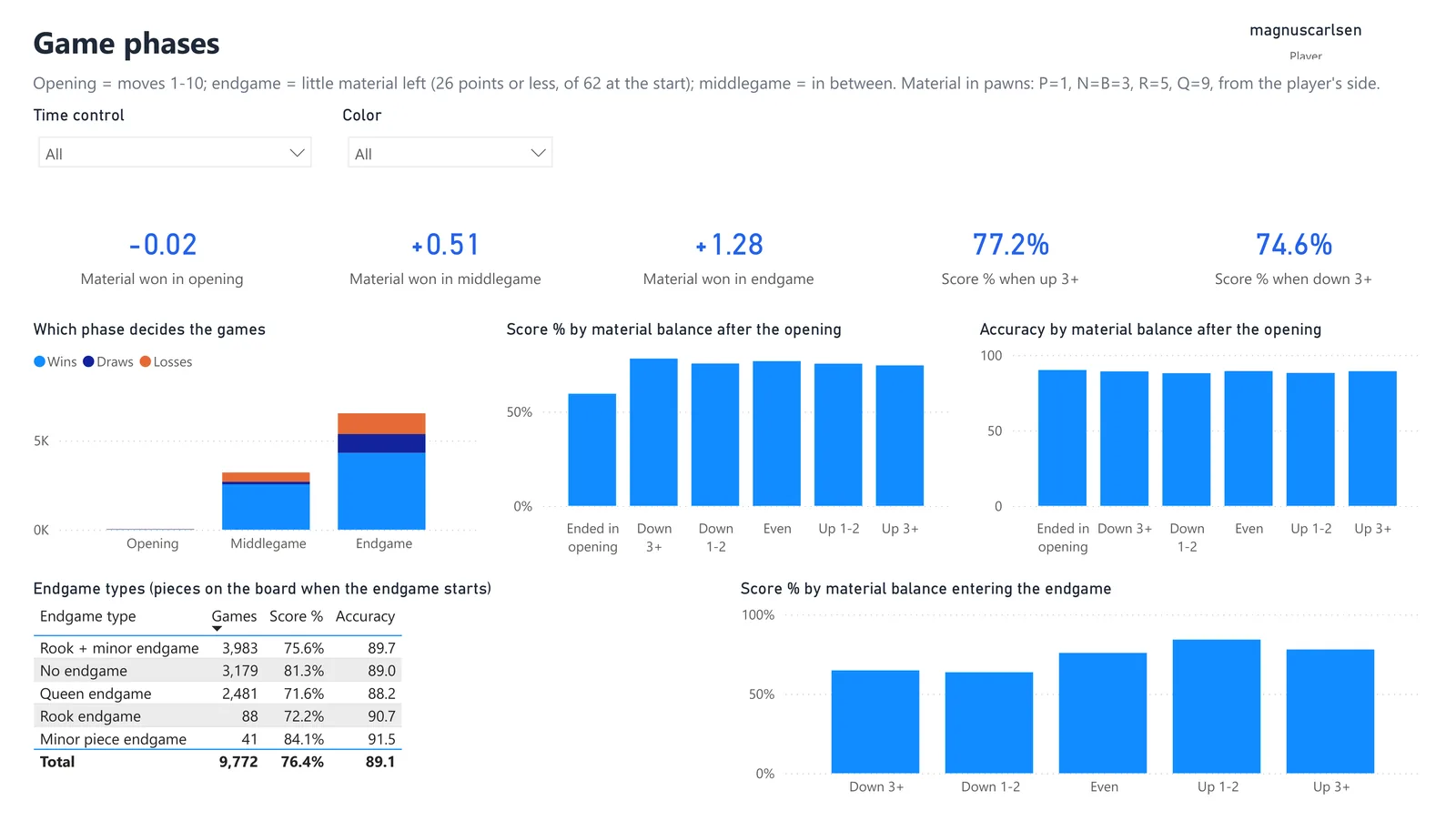
Game phases
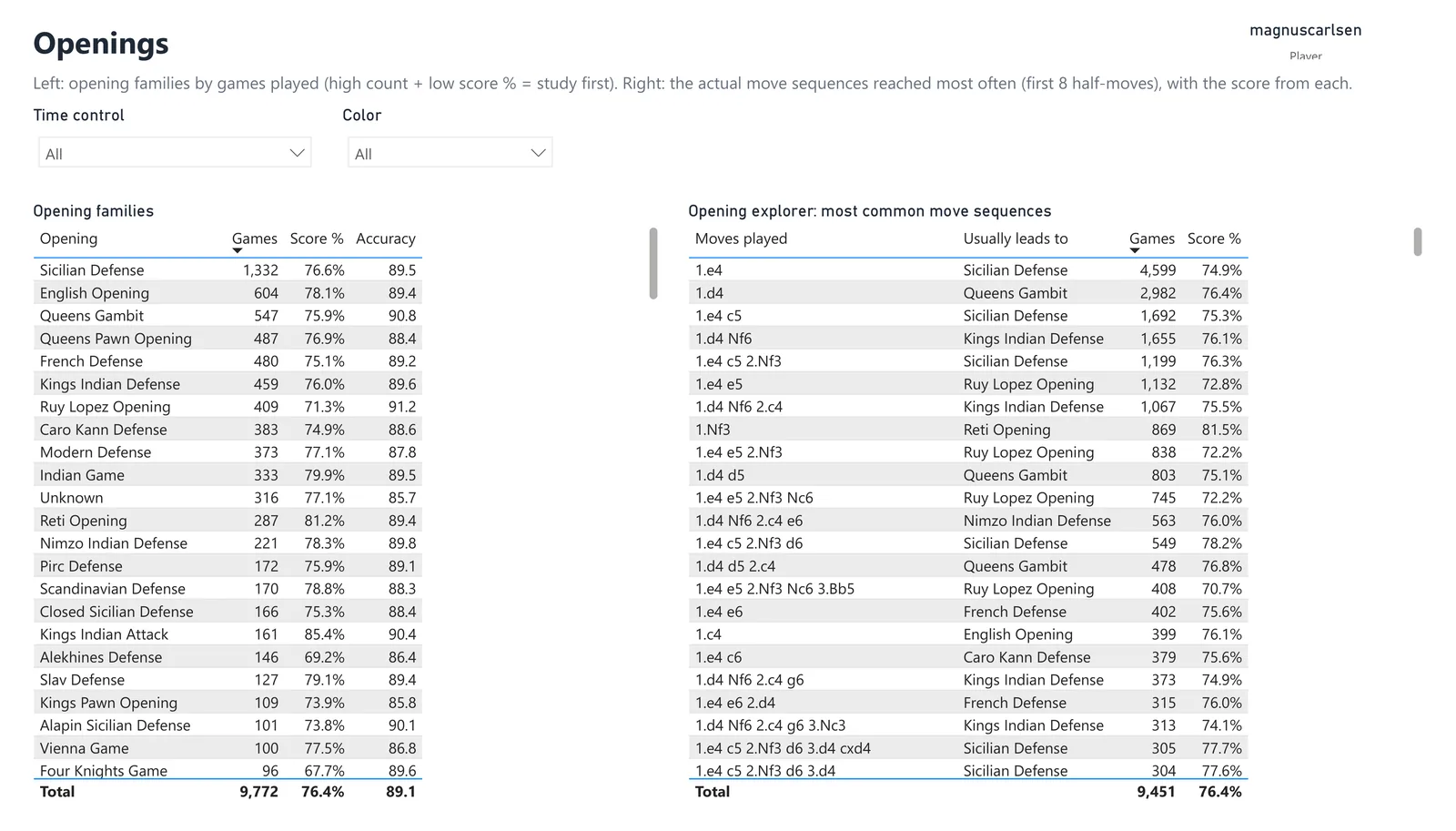
Openings
In short
- Architecture: a medallion lakehouse on Fabric and OneLake.
- Engineering: Data Factory, PySpark, Delta, a config table instead of names in code.
- Modeling: a Kimball star schema with the position kept on the fact.
- BI: a Direct Lake model and report generated from code.
The repository is private and available on request. A live walkthrough shows the most: resume the capacity, run the pipeline, watch the lineage and the report update.